UCU University of Leeds BranchPosted on by Alan Smith
This post is from 2019 and the guidance is not current
This post is from 2019 and the guidance is not current
Reporting strike action
On Thursday 5th December, or on your first day back if you don’t work Thursdays, you should report that you took strike action, via ESS or by email to industrialaction@leeds.ac.uk, as set out in the email from HR on 18th November. You should also report that you are taking ASOS.
If you are on a visa, it’s extra important that you are recorded as having been on strike, otherwise it could count as unauthorised absence which could affect your visa – you might like to report by email and ask for confirmation that your report has been recorded.
Guidance on ASOS
We will be doing the ASOS which was set out in the voting papers for the ballot, and which you voted overwhelmingly for. We are asking you to:
work to contract
not cover for absent colleagues
not reschedule lectures or classes cancelled due to strike action
not undertake any voluntary activities
Your committee, with the help of the packed General Meeting on 3 December, has put together the a document containing local ASOS guidance, available here: [document removed – email ucu@leeds.ac.uk if you would like a copy of the 2019 guidance which is not current]. Also see the national FAQ at www.ucu.org.uk/he-action-faqs
Note in particular that our university management have softened their approach compared to 2018 – they are asking teaching staff to “recover learning” not “reschedule teaching”. We have suggested in the attached document how you should respond to requests for plans on how to recover teaching on your first day back, and ideas for how you might do the recovering. Some local managers are asking staff to reschedule lost teaching – do not do this, because that would be breaking ASOS. Our ASOS guidance document also has guidance for researchers and academic related staff. It has been great to have some Heads of School and other senior staff on the picket lines with us and on strike with us – we recognise they will be in a difficult position, and the document includes some guidance for these members too.
Our ASOS guidance document also includes suggested wording about ASOS to append to your email signature.
At our General Meeting on 3 December we unanimously passed a motion revising the rules for our local Hardship Fund to allow us to provide greater support to members facing financial difficulties due to pay deductions for striking. The local Hardship Fund will work alongside and in addition to the UK-wide Fighting Fund. Members should apply to the Fighting Fund for support initially, except where claiming for days of strike action not covered by the Fighting Fund (day 1 for those earning less than £30,000 gross annually, days 1 and 2 for those earning more than £30,000 gross annually). The local Hardship Fund will the supplement the UK-wide Fighting Fund, or provide support where the UK-wide Fighting Fund cannot. The new rules mean that the Hardship Fund:
Will comply with the appended guidance from UCU to ensure continued solvency of the branch, and that the branch is able to continue to meet all its usual commitments for and on behalf of members;
Will be managed by local branch officers a panel of at least three elected branch officers, including the Treasurer;
Will prioritise members in precarious, low paid work, as per national and local priorities;
Will also prioritise members who can demonstrate that their contractual and/or financial status means that they would be disproportionately impacted by strike deductions;
Will limit the amount that can be claimed by a member to no more than would have otherwise been earned;
Will cap the amount that can be claimed by a member per day to £75, except for the first day of the strike action when the cap will be £150, so long as this is not more than would have otherwise been earned;
Will cap the total amount that can be claimed by a member during the disputes to £1000, so long as this is not more than would otherwise been earned;
Will initially prioritise support in the days 1-2 of the strike (or pro rata equivalent), and subsequently will seek to complement support provided by the National Fighting Fund according to the principles of those most in need first, as outlined above;
Will, where funds allow, seek to support members suffering disproportionate impact from any further deductions made in connection with industrial action (e.g. ASOS) subject to the same principles of prioritisation outlined above;
Will, once the USS pension and the “Four Fights” disputes are over, allow unused funds that originated from the University of Leeds UCU main operational account remaining in the Local Hardship fund to be either transferred back into the branch’s operational funds, retained in the Local Hardship Fund, or sent to the National Fighting Fund.
There will be drop-ins to help members to complete the application form organised over the coming weeks.
[This post was updated 25 November 2021 to replace older versions of the claim form with a December version and to add how to request it in an alternative format. Updated 28 January 2022 to refer to current page.]
From the picket lines this week, two committee members offered polite responses to an editorial in the Gryphon newspaper that addressed the causes of the current industrial action. Dr Laura Loyola-Hernández offered a response covering the chief aspect of the aspect: the four fights. Dr Mark Taylor-Batty offered one on the issue of USS. We reproduce them both here.
Four fights:
A letter to my students
On Monday we were meant to learn about feminist decolonial research but instead I will be striking. I would love nothing more than to be teaching you. I did not come to this decision lightly. I haven’t come across anyone striking that is not worried about their students, specially those that are in vulnerable positions. But as we have heard across picket lines nationwide: our working conditions are your learning conditions.
I write this as a response to the editorial letter in the latest edition of The Gryphon. I find in the arguments a reflection of wider debates happening on the picket line. Many of the conversations have concentrated around pensions. Yes, we are trying to fight to save our pension scheme but this is only one of two disputes. The second is about FOUR connected fights. The strike is also about unsustainable workloads, gender and racial pay gaps, and casualisation. These topics are often marginalised in the debates surrounding the current strikes but are an essential component of the structural inequalities in the education system. More importantly, the people that have often raised these concerns are usually the most vulnerable: PGR students and academic and non-academic staff on hourly paid and fixed term contracts.
According to UCU statistics, the average university employee works 50 hours a week. This does not include the unpaid emotional labour that many womxn, especially Black and Womxn of Colour, do to support vulnerable students and Early career colleagues. Similarly, our efforts to decolonise practices within the university and the curriculum and our fight to tackle institutional racism often go unrecognised. All of this happens while being paid less than white colleagues.
Staff pay has fallen by around 20% in real terms over the past decade. These numbers are worse for womxn, especially Black and WOC. Last year a report from the BBC showed that 86% of staff in Russell Group Universities are white, with only 1% Black. The report also demonstrated that while white women are paid 15% less than a white man, Black and Asian women are paid 39% and 22% less than a white man (https://www.bbc.co.uk/news/education-46473269). The statistics are dire. There are only 26 Black women professors in the UK and: “over a three year period just 1.2% of the 19,868 studentships awarded by all UKRI research councils went to Black or Black Mixed students and only 30 of those were from Black Caribbeanbackground” (https://leadingroutes.org/the-broken-pipeline).
According to the University of Leeds gender pay gap report (https://equality.leeds.ac.uk/wp-content/uploads/sites/64/2019/11/J000449_Gender- Pay-Gap-Report-2019_Final-Published.pdf), there is an 18.9% gender pay gap in our institution. Despite knowing that 73% of Leeds staff is white (https://equality.leeds.ac.uk/wp-content/uploads/sites/64/2019/01/All_Staff_in- post_2018.pdf), there are no formal statistics with regards to the extent of the racial pay gap in our institution. These structural inequalities are also reflected in our student body. Only 17.6% of home/EU students are BME while there is a 12% BME attainment gap. We must understand these numbers not as the cause of inequality but as symptoms of sexism, institutional racism and misogynoir in our universities.
Casualisation is pervasive in our sector with 49% of teaching-only academics and 67% of research-only staff on fixed term contracts. Forty-nine universities still use widely discredited zero-hours contracts for academic staff. According to a recent report by UCU, part time and hourly paid teachers are doing 45% of their work without pay, 71% said that their mental health had been damaged by working on insecure contracts (https://www.ucu.org.uk/media/10336/Counting-the-costs-of- casualisation-in-higher-education-Jun- 19/pdf/ucu_casualisation_in_HE_survey_report_Jun19.pdf).
What about Leeds University? Our institution employs 65% of its research staff and 36% of its teaching only staff on fixed-term contracts, as well as employing 1,343 academics as atypical workers (https://www.leedsucu.org.uk/wp- content/uploads/2019/01/University-of-Leeds-UCU-AntiCas-Claim-Jan-2019.pdf). Many of them are postgraduate students working as teaching assistants and employed as temporary casual workers. They have limited or no sick pay, holiday pay and other employment benefits. How are we to support our students and their mental health when ours is broken?
Workload, gender and racial pay gap and casualisation affect our pension scheme. If we are paid less while we are working, we will receive less while in retirement. Unhealthy workloads, sexism and institutional racism tend to push out Black and POC out of the sector, particularly womxn and non-binary people.
I am a WOC immigrant on a fixed term contract. Many migrant UCU members are striking knowing that we might not be in this country in six months or in one or two years because of draconian immigration policies (Hostile Environment), precarious employment and pay gaps. We are striking with genuine fear of the Home Office. We are also striking for eight days without pay. We have asked that lost pay be given to the Student Hardship fund and support of student mental health. We are striking because we believe that a better university is possible for students and staff.
I am striking for migrant students who can’t and whose immigration status is being weaponised to break the strike. I’m striking for students who do not feel heard, seen, that have been invisibilised and made to suffer because of their race, gender, immigration status, religion, sexuality, mental health, disability and chronic illness. I am striking for those who have not felt heard and supported by our union. I can only continue to push for change both within UCU and our universities. And yes, I also strike for those who can and choose not to. I believe in the power of collective action. I’m striking for the ones coming behind me, for the future generations because our working conditions are your learning conditions.
USS:
A pension-focussed response to the @TheGryphonLeeds editorial, politely to offer some granularity and fact-checking to the soundbites.
Pensions are dull as dishwater, and complex in structure. But in recent years, they have fired up staff, because of the needless damage that employers have sought to visit upon them. Last year’s 14 days of strikes specifically concerned defending our pensions, and that dispute was put on hold with the forming of a Joint Expert Panel. It is true that UUK institutions broadly welcomed the setting up of the JEP, and then its recommendations. However, all but a couple of those recommendations have now been applied to the valuation, and it is a fact that UUK has done little to nothing to urge USS to apply all those recommendations, which were approved by both their and UCU’s auditors and actuaries. We know that if those recommendations could have been applied to the 2018 valuation, then we would already be in a position of ‘no detriment’ and there would be no dispute in that corner. It was this ‘bait and switch’ behaviour that led us to the current situation, and pensions being one of the disputes this year.
There has been plenty of discussion of the UUK proposal to increase our contributions to 9.1%, but it has been clear that the purpose of the late-in-the-day 9.1% ‘offer’ was to fabricate an illusion of the employers being reasonable, which only those not properly paying attention could really be convinced by. The reality was that we had already seen a historic 10% rise in their contributions from 8% to 8.8% earlier this year, for no extra gain. Crucially, we should also recall that the employers gave themselves a ‘contribution holiday’ by lowering their contributions by 4% from 1997 to 2009. Had they not done so, there would never have been any ‘deficit’, however badly it is calculated. What is more, their own actuaries indicated in responses to USS that they could afford the kinds of increases that would cover these losses which their contribution holidays were instrumental in constructing. Employers in the post-92 sector are already paying the kinds of contributions (to the TPA pension) that our more established universities are arguing are ‘unaffordable’. There is little mention of these facts in reporting around this issue, sadly.
Let’s look at the valuation, from which the notion of our pension being in ‘deficit’ arises. The current value of the pension pot is £68.5 billion. Under £3 billion each year goes to pensioners and all other scheme costs. More than that £3b amount actually comes in annually from contributions – what we and the employers pay in each year has pretty much always more than covered what needs to go out of the scheme. So, the now £68.5 billion remains untouched, year after year, and just keeps growing in value (and the net returns on investments also more than covers what goes out). This has been the situation for decades. Now, there is a regulatory requirement to consider what would happen if a business goes bust, and that is as it should be, but in this situation that means applying a single-employer regulation to a multi-employer scheme. The ‘deficit/surplus’ is simply a calculation of whether there will be enough money in the future to pay all pensions if Universities start going bust. You can calculate a ‘deficit’ in twenty years’ time if, for example, you assume wage growth way beyond that you are actually willing ever to concede, and if you insist on selling high yielding stocks and replacing them with low-yielding bonds (so-called ‘de-risking’) (stop yawning at the back). Yes, there is important talk of the the Pension Regulator, who are currently investigating behaviour in the scheme, but they absolutely do not require USS to calculate the ‘deficit’ in the way that that do.
When Universities pushed to shift our pensions scheme away from a ‘final salary’ scheme earlier this decade, people of my generation saw a drop in the value of their pensions of tens, even hundreds of thousands of pounds over the course of their future retirement. The employers used to argue that if we didn’t get inflation-beating pay rises, that we at least had a strong pension waiting for us. That argument unsurprisingly and noticeably has evaporated in recent years. The concerted shift to push to switch us to ‘defined contribution’ pensions last year (that is, a pension in which all we know is how much money goes in, not at all what comes out) caused that dispute, and that threat is still very much in the balance now if we fail to hold ground this year. This will have disproportionate impact on the pensions of younger members of staff. None of this was necessary, and the blame and onus to correct is on the employers. Thanks for your time reading this.
This is a practical data hack workshop where we will scrape, analyse and visualise the data and discourses of the strike. ideally would run as 2 or 3 50 minute slots – or as an additional event.No experience necessary! Just bring a laptop and your extension cable to make sure the battery doesn’t run out! We will teach some basics to scraping and coding, data visualisations and analysis and critically interrogate how the strike actions and pension dispute have been presented. Perhaps we could look at the language used across national media, the statistics used to defend positions, or the longer data histories of the pension dispute. We could look at university policy documents, VC letters across universities, or union publicity for example.
1pm – 3pm, Quaker Meeting House
Jews in the Medieval Imaginary
Eva Frojmovic
1pm – 3pm, Leeds Central Library, Art Library
The state of PGTAs at Leeds: discussion and fact-finding
UCU committee
1pm – 2pm, Quaker Meeting House
Fleabag: Sex, Confession, and the Camera
Carl White
2pm – 3pm, Quaker Meeting House
Strike pay surgery
UCU committee
1 pm onwards, Quaker Meeting House
Support with filling in forms to claim from the national Fighting Fund and the local Hardship Fund. (NB Claims can’t actually be submitted till you have proof of the pay lost by striking).
Street Theatre Performance!
Masters students @PCI_UniofLeeds perform their street theatre play, Students Strike Back!, in support of #UCUstrikes on Woodhouse Lane. Various times from 10 a.m.
(for day of action on disability equality in education)
Jo Ingold with Liz Oliver
1pm – 2pm, Quaker Meeting House
The Mathematics of Voting
Rob Sturman
1pm – 2pm, Quaker Meeting House (upstairs room)
Healthcare and the Pharmaceutical Industry: What Is To Be Done?
Dan Howdon
2pm – 3pm, Quaker Meeting House (upstairs room)
Student mental health and the role of academics – an open conversation
Rachel Muers
2pm – 3pm, Quaker Meeting House
Opportunity for conversation between academics and students about academics’ role in relation to student mental health problems. This is a discussion & sharing of ideas facilitated by a non-specialist.
Building a coalition for climate action @Leeds
Gabriella Alberti
2pm – 3pm, Fenton pub
How do we do action short of a strike? UCU Researchers @Leeds
Drasko Kascelan
3pm – 4pm, Fenton pub
Training Sawbones: A (slightly) ghastly history of teaching doctors in Leeds
Guided walk around Leeds. Meet in the Grand Arcade’s exit to Vicar Lane, LS1 6PG. We’ll finish near the LGI.
Polina Merkulova
1pm – 3pm.
How did people become doctors in Leeds? Why were some students expelled?Who were the teachers? Who and how could access medical help? What does architecture have to do with all of these? While wandering around the city we will answer these and many other questions, talk about student pranks, learn the history of some of Leeds’ iconic buildings and step into the lives of medical students, teachers and patients from the early 19th century onwards. There will be “hard facts”, curious anecdotes, urban legends and gruesome stories of disease, blood and broken bones. No prior knowledge is needed and all are welcome! The walk will take approximately 2 hours and will be around 2 miles long with frequent stops. There is a nice pub nearby where we can warm ourselves and chat about Leeds’ medical history a little more after the walk.
Out of Office: Foraging and Feminist Reading in Meanwood Park
Elspeth Mitchell with Asa Roast
2pm – 4pm.
Meet at the entrance to Meanwood Park Café
Part reading group, part mushroom foraging, part holly and ivy gathering expedition. Bring your mushroom ID books, mushroom knives and baskets — or just yourself! We will provide copies of extracts from two texts, (‘Nose Hair: Love it or Leave it? the lovecidal of bodies that filter’ by Xin Lui and ‘Unruly Edges: Mushrooms as Companion Species: For Donna Haraway’ by Anna Tsing) which we will read and discuss while foraging for fungi. As it is quite late in the season for mushrooms, Asa will share with us the best spot for ivy in the park. The walk will last at least two hours and you are welcome to join us for a drink afterwards. Please dress warmly and wear suitable footwear. To register your interest and for any questions contact: elspethrosemitchell@gmail.com
UCU University of Leeds BranchPosted on by Alan Smith
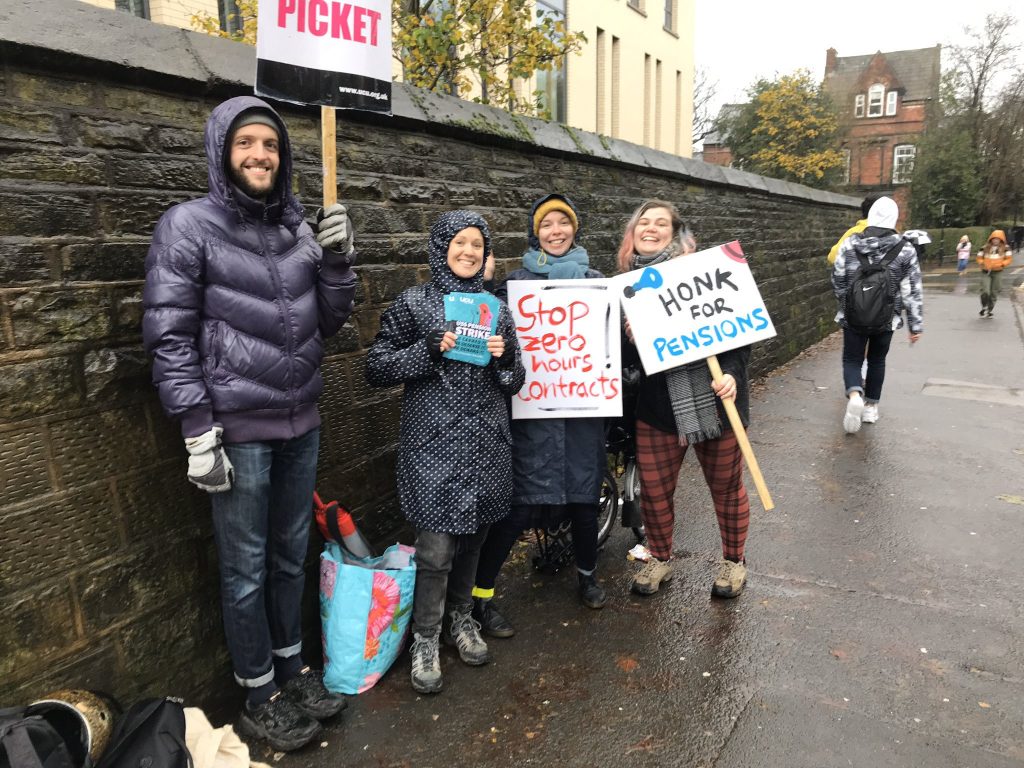
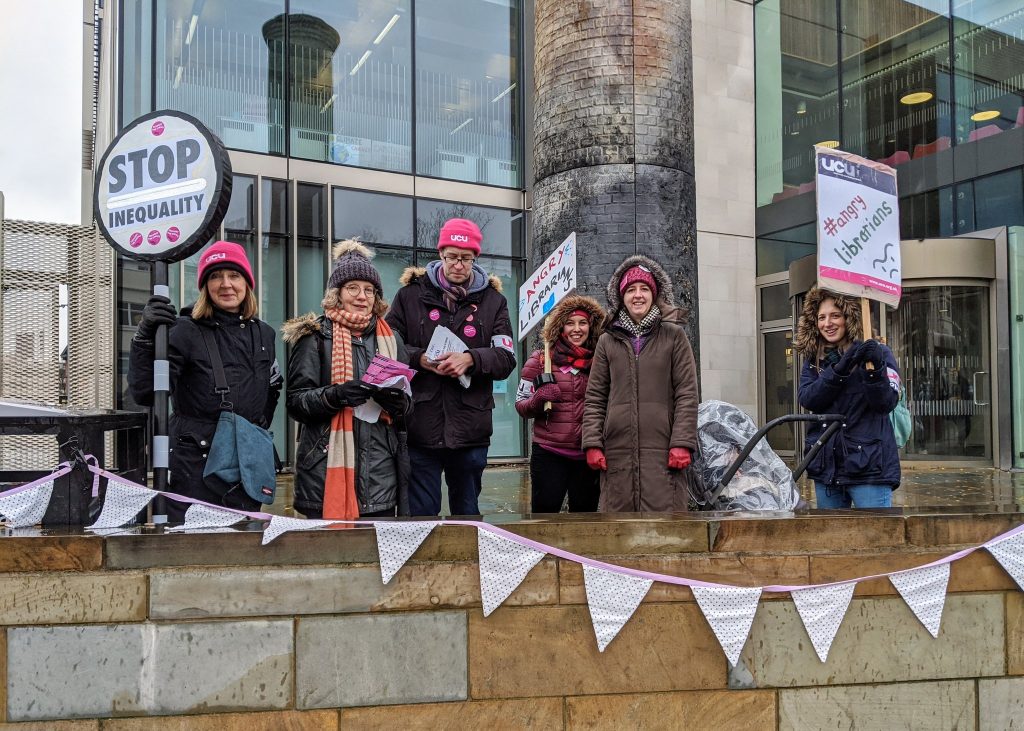
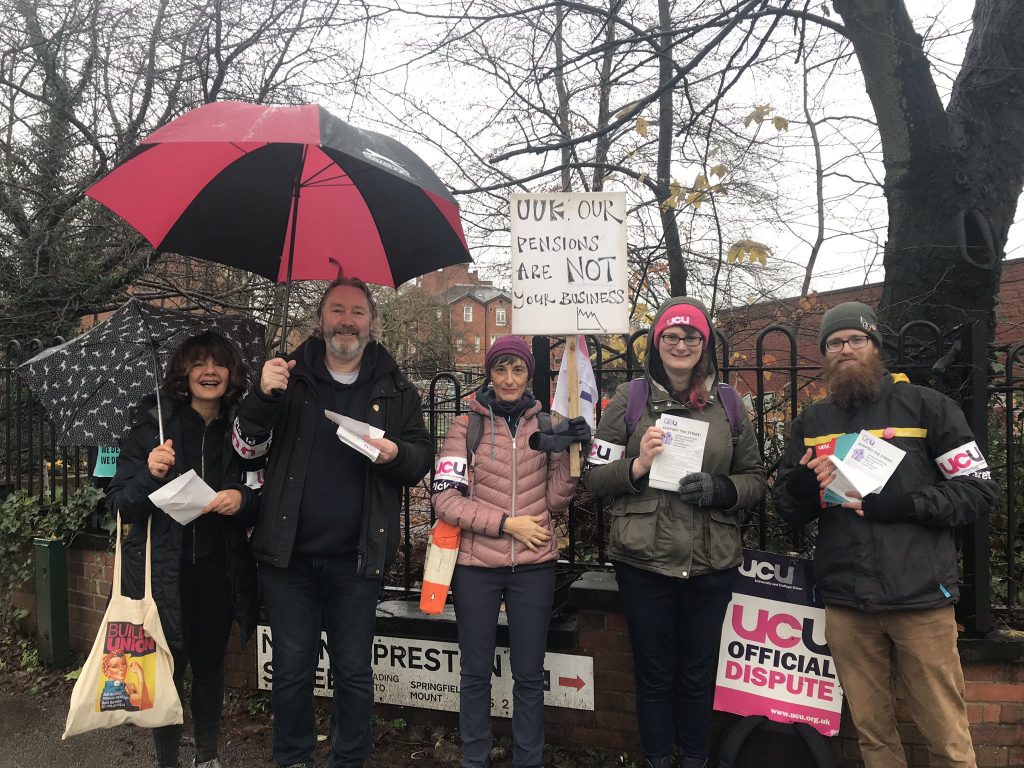
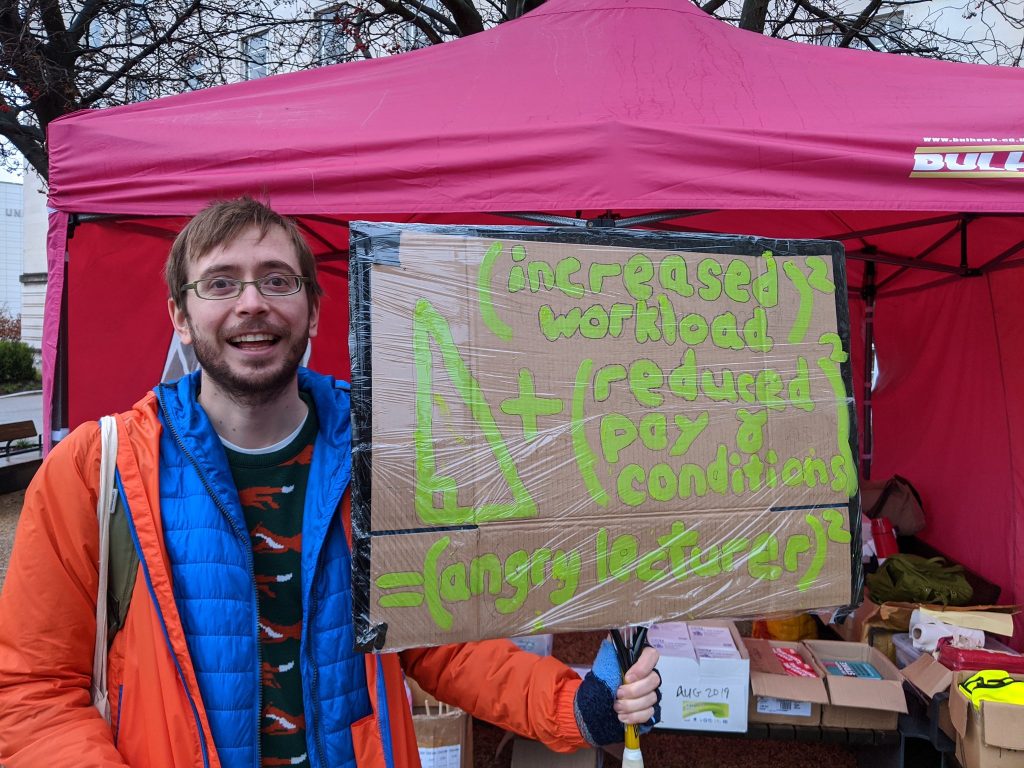
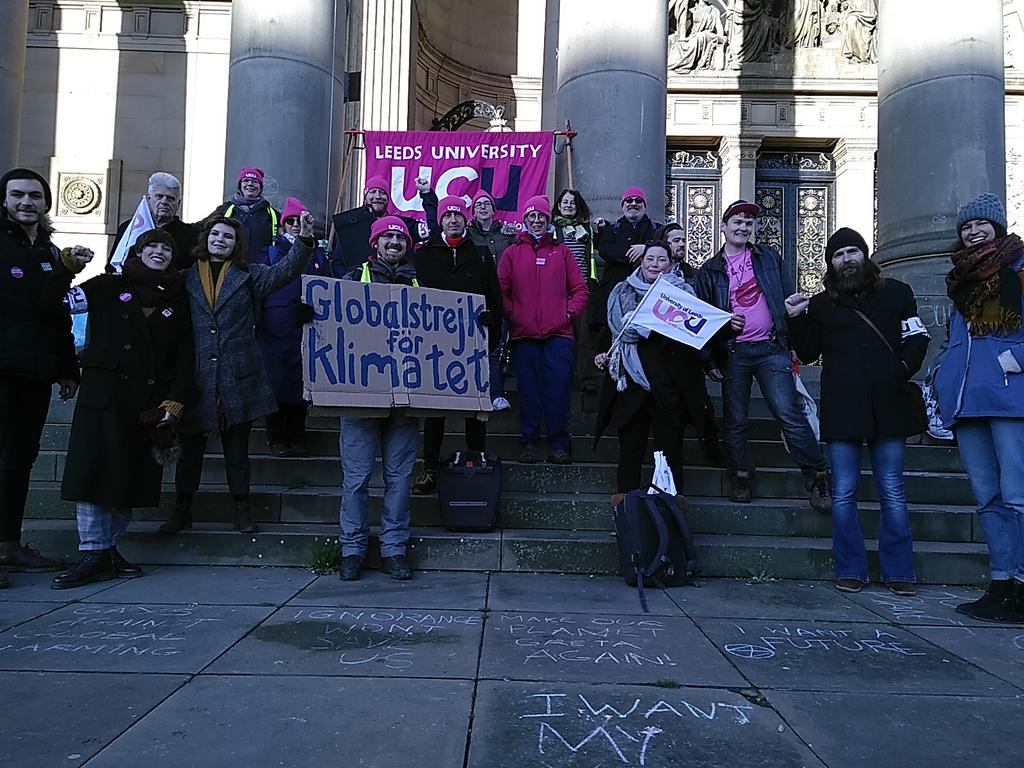
Leeds UCU standing firm, picketing in the rain, and then on Friday 29th moving on to support the Youth Climate strikers. Keep it up everyone, 8 days strong! The weather is due to be better next week, sunny but cold, so wrap up warm.
Migrant Detention These Walls Must Fall (North West)
A talk by migrant support grassroot group. We hope to organise this in collaboration with student societies, for example Leeds STAR, and use it to help kick-start activism against immigration detention by students and staff
Lauren Cape-Davenhill
1pm – 2pm, Quaker Meeting House
Decolonising the University: A Jewish perspective
Joshua Alston
1pm – 2pm, Quaker Meeting House
Short workshop aimed at how we can decolonise the university and what Jewishness can bring to the discussion. No knowledge of Judaism or academic decolonisation required.
The medieval mediterranean, race, and religion
Jonathan Jarret, Francesca Petrizzo, Eva Frojmovic
2pm – 3pm, Quaker Meeting House
Migration control and crises in the neoliberal economy
Richard Cleminson, Deirdre Conlon, Glenda Garelli, Louise Waite
2pm – 3pm, Quaker Meeting House
Short conference style presentations: ‘migration, crises, and European borders’, ‘UK/US immigration detention economies’, ‘the case of modern slavery in the neoliberal economy: migrant ‘illegality’ and exploitative work’; “Black Lisbon”: Anarchism, Anti-colonialism and the Portuguese-speaking world (1920-1940); followed by open discussion.
Introduction to Permaculture
A design science for sustainable livelihoods. a.k.a. Revolution disguised as organic gardening.
UCU University of Leeds BranchPosted on by Alan Smith
Text from branch president Ben Plumpton’s email to members27th November
Negotiations
The most important thing to tell you is that our UCU negotiators on pay and conditions met with UCEA, the employers organization, on Tuesday. See UCU’s statement about that meeting. This is really important, because it shows it only took one day of solid striking and record breaking pickets to get UCEA to do what they should have done weeks ago; sit down and talk. However, they are still not willing to talk about pay. We need to push them harder on this, because stopping pay erosion is central to our claim and low pay is one of the issues which creates pay gaps and which exacerbates the already impossible position of casualised staff. UCEA are now consulting with university leaders. We need to send our Vice-Chancellor a clear message that our claims are urgent and that we won’t settle for anything other than substantial change.
For those striking, please stand firm. We need to sustain our action. We want to make our pickets (physical and digital) bigger, louder and clearer, so help us make some noise over the next few days.
If you are not yet striking, please come out with us now – this is an important dispute which we can win if we stand together. You will be very welcome.
We’ve had 50 new members join UCU in the last couple of weeks which is great. Keep encouraging colleagues! New joiners to the strike at this stage make a huge difference.
You are wonderful
What fantastic pickets you are – arriving early and standing around in the damp, and then willingly singing in the rain and cheering at our rallies! Thank you thank you. Don’t forget, it’s OK to take some time for yourself, you don’t have to come every day. If you’ve been picketing with a group of colleagues, you could organise yourselves a rota so everyone gets a rest day. Big thank you to people new to picketing – more are joining us every day – it’s quite an experience isn’t it? We’re picketing every day from 7:30 (come to the pink gazebo near the main entrance) followed by a rally on Parkinson steps at 11:30. If you want to picket and have particular needs, we are keen to provide support and adjustments so that you can join us. Please email ucu@leeds.ac.uk and let us know how we can make that work for you.
Remember that striking includes not working from home, not dealing with your emails (*except UCU emails of course, please keep reading those!), no work-related social media, and generally not doing anything that counts as work, wherever it might be done. Hope you manage to do some enjoyable stuff during this time!
Hot breakfasts on Monday 2 December
Our friends in Unison have very kindly offered to provide us with hot breakfasts on the first day of the second week, starting at 8 am. We’re keen to start the second week with really impressive picketing, so hopefully this will encourage everyone along!
More solidarity from (and with) our sister unions
We’re pleased that the Unison and Unite branches at the university have advised their members not to pick up work which would normally be done by UCU members. This of course makes our strike more effective and we are grateful for their support. It also means that, when are back at work and doing Action Short of a Strike, we will need to be careful not to put extra workload on these colleagues.
Reminder: Benefit gig Friday 29 November 7 pm
At the Chemic Tavern, 9 Johnston St, LS6 2NG. Pay what you can, in aid of our Hardship Fund. More details here. Pass the word around, bring your friends, let’s have a great evening celebrating our first week of strike action!
Reminder: Climate march Friday 29 November 12:30 Parkinson steps
This is entirely separate from the UCU strikes, but lots of staff and students, including UCU members, will be marching down to town to support the next big Youth Strike for Climate event. Our strike rally will finish about noon, followed by some climate emergency speeches, and then the march leaving Parkinson steps at 12:30.
Thankfully it’s looking like the weather will improve on Friday and for next week… Keep on tweeting and Facebooking and everything (use #UCUstrikes and tag @leedsucu) – we love seeing your photos.
In solidarity,
Ben Plumpton Pronouns: She/Her/Hers University of Leeds UCU President
Some of the website tools used on this website set cookies on your browser. The website should work fine if you DISABLE all except the necessary cookies. If you click “Accept” you consent to the use of ALL the cookies.
This website uses cookies to improve your experience while you navigate through the website. Out of these, the cookies that are categorized as necessary are stored on your browser as they are essential for the working of basic functionalities of the website. We also use third-party cookies that help us analyze and understand how you use this website. These cookies will be stored in your browser only with your consent. You also have the option to opt-out of these cookies. But opting out of some of these cookies may affect your browsing experience.
Necessary cookies are absolutely essential for the website to function properly. These cookies ensure basic functionalities and security features of the website, anonymously.
Cookie
Duration
Description
cookielawinfo-checbox-analytics
11 months
This cookie is set by GDPR Cookie Consent plugin. The cookie is used to store the user consent for the cookies in the category "Analytics".
cookielawinfo-checbox-functional
11 months
The cookie is set by GDPR cookie consent to record the user consent for the cookies in the category "Functional".
cookielawinfo-checbox-others
11 months
This cookie is set by GDPR Cookie Consent plugin. The cookie is used to store the user consent for the cookies in the category "Other.
cookielawinfo-checkbox-necessary
11 months
This cookie is set by GDPR Cookie Consent plugin. The cookies is used to store the user consent for the cookies in the category "Necessary".
cookielawinfo-checkbox-performance
11 months
This cookie is set by GDPR Cookie Consent plugin. The cookie is used to store the user consent for the cookies in the category "Performance".
viewed_cookie_policy
11 months
The cookie is set by the GDPR Cookie Consent plugin and is used to store whether or not user has consented to the use of cookies. It does not store any personal data.
Functional cookies help to perform certain functionalities like sharing the content of the website on social media platforms, collect feedbacks, and other third-party features.
Performance cookies are used to understand and analyze the key performance indexes of the website which helps in delivering a better user experience for the visitors.
Analytical cookies are used to understand how visitors interact with the website. These cookies help provide information on metrics the number of visitors, bounce rate, traffic source, etc.
Advertisement cookies are used to provide visitors with relevant ads and marketing campaigns. These cookies track visitors across websites and collect information to provide customized ads.