Please download, print and display these posters on your office doors and other areas visible to students.
Gender pay balance poster – click here to download
Casualisation poster – click here to download
Pay campaign poster – click here to download
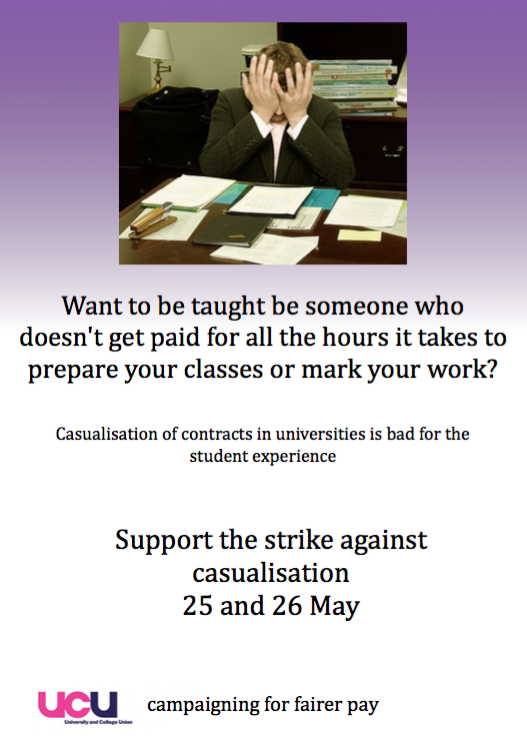
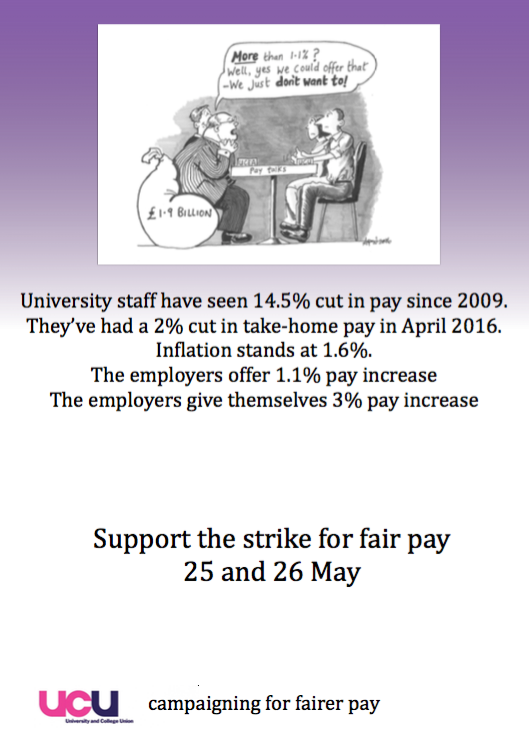
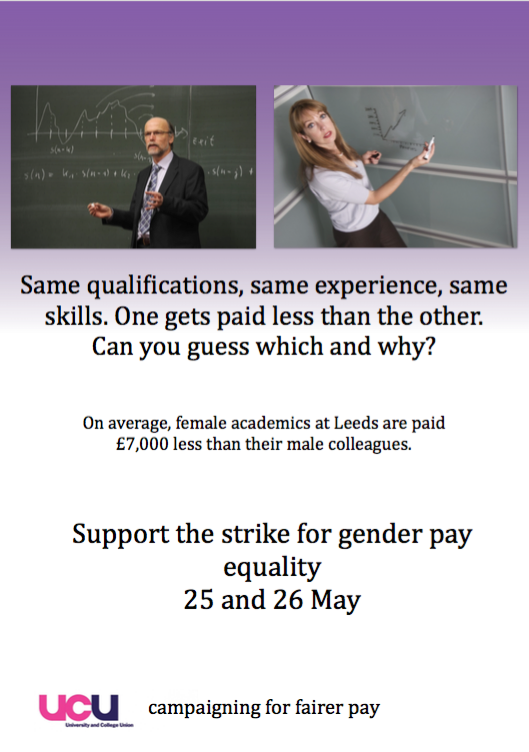


Please download, print and display these posters on your office doors and other areas visible to students.
Gender pay balance poster – click here to download
Casualisation poster – click here to download
Pay campaign poster – click here to download
Dear Vice-Chancellor,
I am writing this open email to you on behalf of UCU members at the University of Leeds. As you know, in the meeting of New Joint Negotiating Committee for Higher Education Staff last week, the university employers made a full and final offer of a 1.1% pay rise for 2016, fractionally improving upon the 1% opening offer. I hope you will recognise the shock and disappointment felt by staff to what comes across as a derisory and deliberately provocative stance.
Last year, when the employers insisted upon a 1% final offer for 2015, the university’s remuneration committee was in a position to decide whether senior members of the university executive group should receive any more than the 1% that it was argued was all that was affordable for the rest of us. Despite the university’s claim to transparency, and despite this group of senior staff being within the UCU constituency, we have not to date been told whether or not that small group received anything more than our 1%. I’d like to ask you now to make the figure public.
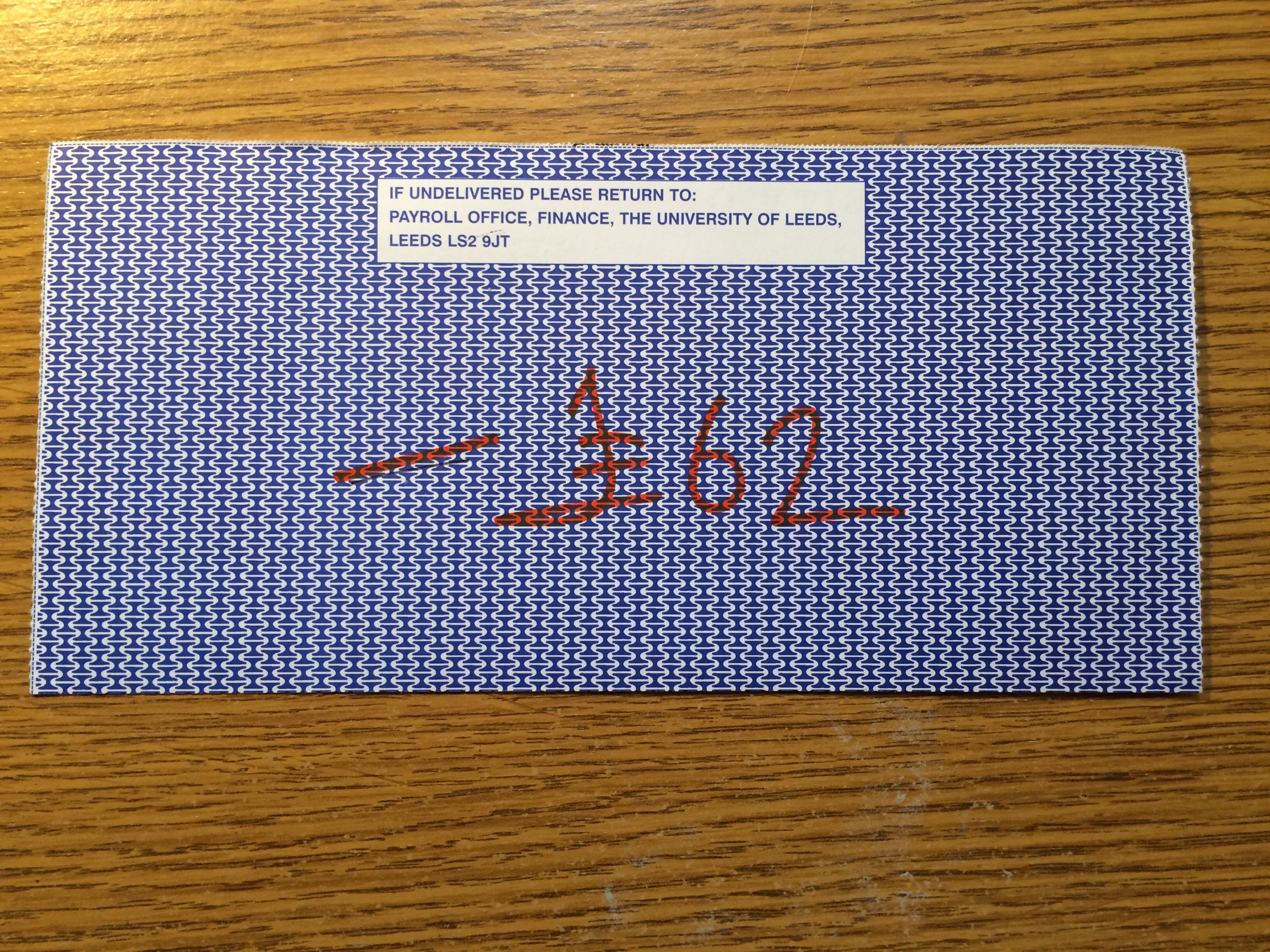
At the end of April, staff in former National Insurance opt-out pension schemes received a cut to their take home pay, in the form of increased NI contributions and, within USS, increased pension contributions. For UCU members in USS, this together was pushing a 2% cut to take-home pay, with the biggest losses seen by the youngest staff in the post-2011 career average USS scheme. For the purposes of illustration, I append a screen-grab of my own net salary from recent months, which I use to represent my members. You’ll see I took a cut to take- home pay of around £34 a month, or £410 a year. When we asked members to share their loss using the hashtag #aprilpaycut we saw that the average loss declared was between £400 and £600. To put that in perspective for you, that’s a Christmas budget, or a month’s rent or mortgage for many families. This actual cut to take-home pay is on top of the 14.5% average cut to the value of my colleagues’ pay against inflation over recent years.
In light of this, you must know that if you seek now, alongside other university leaders, to argue for nothing more than a 1.1% pay increase for 2016, you will be arguing that we should end negotiations with staff actually worse off in take-home pay than when we began those negotiations. Would you join me in supporting your colleagues around the university and recognise that this 1.1% final offer represents neither a dignified nor professional attitude to negotiation on UCEA’s part? Can you assure staff that neither you nor the UEG approved the 1.1% final offer in sending your representation to UCEA? It certainly falls short of the pay increases factored into IPE projections as affordable, and is a long way short even of the national average pay settlement.
As the union and the employers now find ourselves in a dispute over this matter, might I request that the University Executive Group, who might well have received a significant pay increase over the rest of us, now respect the dignity of those who wish to see a pay increase that recognises and rewards their long hours, hard work and intrinsic value to the institution, and who wish to see women paid the same as men for the same work, and acknowledge that (demonstrated by an unambiguous ballot outcome) the actions colleagues are prepared to take to support those ambitions are honourable in intent?
Our team will be happy to hear from you at Monday’s Joint Committee of the University and the UCU, and I can subsequently communicate your responses to my colleagues in the union across campus.
President, UCU at University of Leeds
We recently informed you about the reduction to your pay that will occur at the end of this month: https://www.leedsucu.org.uk/archives/1973
Check your April salary statement, to see how much you have lost this month compared to your March payment. Or indeed compared to March 2015.
Most people can now check their salary statements online:
Go to this link – http://hr.leeds.ac.uk/info/6/support_for_staff/274/employeemanager_self_service_information
and follow the link to self service log on.
Use your usual details to log in, and then click on ‘benefits and payment’ on the left. Then click on ‘salary statement’.
In the overview there, you can see the date of the salary and the net payment. Look at the amount next to 29.04.16 and then below it at the amount for 31.03.16.
Send us a photograph of the back of a payslip with your loss written on it to ucu@leeds.ac.uk, and we will collate them anonymously. Alternatively, tweet your loss compared to March to @leedsucu with the hashtag #aprilpaycut
Remuneration committee agrees the salary increases for senior staff on the university executive group. In full knowledge that the university was supporting an increase of no more than 1% for those of us who produce the university’s work, how much on average did the committee award senior staff last summer? Or was there no more than the 1% they thought we all deserved?
The university has not yet published that average salary increase, so we’ve made a competition out of it. Guess how much the average salary increase of senior management was, including the 1%, and you could win a cake baked by our UCU branch president.*

[CP_CALCULATED_FIELDS id=”7″]
*The winner will be the person who guesses the closest the actual percentage increase. Competition subject to the University publishing the information. Competition open to University of Leeds UCU members only. Competition not open to members of University of Leeds Council, Remuneration committee, or their families.

As the ballot opens, we want here to make clear what your union is asking for:
Unite, UCU, GMB and EIS submitted the following key points of the national claim for this year’s new JNCHES negotiations.
The employers have so far only suggested:
Your ‘yes’ vote for both strike action and action short of a strike are crucial to he effective negotiation of these points.
How much will you be losing this month?
We recommend that you keep hold of your March payslip, stick it on your fridge and keep it to hand, to compare with the one you’ll get in April and after. You will then clearly see the effect of the increases in National Insurance and of USS Pensions contributions, and what these will do to that 1% pay rise the employers imposed last year (if it hasn’t already been eroded by your increased car-parking, commuting and/or childcare costs). You might have seen the THES article on this matter.
This further erosion of your pay is on top of the real-terms erosion of the value of your pay by around 15% since 2009. And, if you happen to be a women, then statistically it is proven you are likely to be paid up to 12% less in academia than the men doing the same job. You can check the difference for you specific to Leeds against your male counterparts here:
https://www.ucu.org.uk/article/8087/HE-rate-for-the-job
We’d like to do something about all this, if you’re prepared to join in.
Do follow details of our national pay campaign here: https://www.ucu.org.uk/he2016
Details of the forthcoming deductions from your pay
Firstly, members of USS pension scheme will see their contributions to that scheme increase next month to 8% of your salary, up from 6.5% for CRB members (those who joined after April 2011) and from 7.5% for Final Salary members.
The government has announced changes to National Insurance contributions from April 2016. From 6 April 2016, USS pension members will no longer receive the 1.4% National Insurance rebate and will pay a higher rate of National Insurance, with contributions increasing from 10.6% to 12% on middle band earnings (ie. earnings between approximately £8,064 and £43,000 per annum in the 2016/17 tax year).
The change in National Insurance contributions is happening as a direct consequence of a change in the State Pension which will also take effect at the same time Currently, the State Pension is made up of two parts: the basic State Pension and the additional State Pension (often referred to as the State Second Pension (S2P) or previously SERPS). Members of USS are currently ‘contracted-out’ of the additional State Pension and consequently pay National Insurance at a lower rate. For people who reach State Pension Age on or after 6 April 2016, a new State Pension will replace the existing basic and additional State Pension, which will end the practice of contracting-out. As a consequence, all staff will pay the same ‘contracted-in’ rate as they build up the new State Pension in addition to their workplace pension.

 Support the doctors at Leeds General Infirmary this week. On Wednesday 9th and Thursday 10th March from 8.15 am until around 11am there will be a demo at the mini roundabout outside Jubilee Wing/A& E supporting the main picket of junior doctors. The Leeds UCU banner will be there! If you can get to St. James they will be gathering outside the main entrance from 8am until 12ish.
Also on Thursday 10th March from 5-7pm outside LGI help join hands and bunting round the LGI in defence of our NHS and in support of the NHS reinstatement Bill. Meet at the entrance to Brotherton Wing opposite Millennium Square. The Bill aims to stop privatisation, restore the Secretary of State’s duty to provide a comprehensive, national health service, get the market out of health and deal with ludicrous PFI debts, which are bankrupting hospitals. Bring banners, placards, etc.
All welcome! Thanks to Leeds Keep Our NHS Public for the information.

On international women’s day we’ll be screening the UCU short film:
Followed by a discussion on the gender pay gap in higher education.
Tuesday 8 March
12pm—1pm
Baines Wing room 1.06
This is an open meeting: members, non-members, and students welcome.
UCU  contributed to the Leeds university ‘Students Not Suspects Tour’ debate in the Conference Auditorium on 1 March. Lesley McGorrigan, UCU NEC member and local Campaigns Officer addressed the meeting alongside Moazzam Begg, former Guantanamo prisoner, detained for two years without charge and Rahmaan Mohammadi, school student questioned for campaigning for Palestinian rights.
The meeting discussed the ramifications of the ‘War on Terror’ and its use in legitimising and further propelling the pro-war agenda by ‘othering’ and scapegoating Muslims at home and abroad. The meeting heard some of the of victims’ tragic experiences of Islamophobia alongside ramifications of the ‘Prevent’ duty in undermining academic freedom and the relationship of trust between staff and students.
Section 26 of the Counter-Terrorism and Security Act 2015 includes a duty for public bodies including colleges and universities to have ‘due regard to the need to prevent people from being drawn into terrorism’. In schools, colleges and some Universities this has led to a new culture of stifling debate and democratic expression for one section of our society in particular, Muslims. For example:
These are just a few examples in which Prevent has taken action and found no threat of terrorism. All that resulted was that the pupils and students referred felt nervous and frightened about what they can and cannot say or do. There was consensus at the Leeds meeting on the need for student and staff unions to unite in challenging this McCarthy style legislation.
As part of our campaign to improve workloads UCU has organised an open meeting at 1pm today to discuss workloads.
It’s in the Maurice Keyworth Building, Seminar Room 1.33.
Come along and discuss your concerns and your ideas.